
Arizona’s Colorado River outlook makes conservation at every scale more important than ever. One overlooked source of potable-water use may be hiding in the routine maintenance of backyard pools: cleaning cartridge filters with a garden hose, even though those filters can be professionally cleaned using reclaimed and recycled water.
The Unknown Water Thief in Your Backyard
Arizona homeowners are becoming increasingly aware of how precious our water supply is. We watch reservoir levels, hear about Colorado River shortages, install water-efficient fixtures, and rethink how we landscape our yards.
But there may be an unknown water thief hiding in the way thousands of Arizona pools are maintained.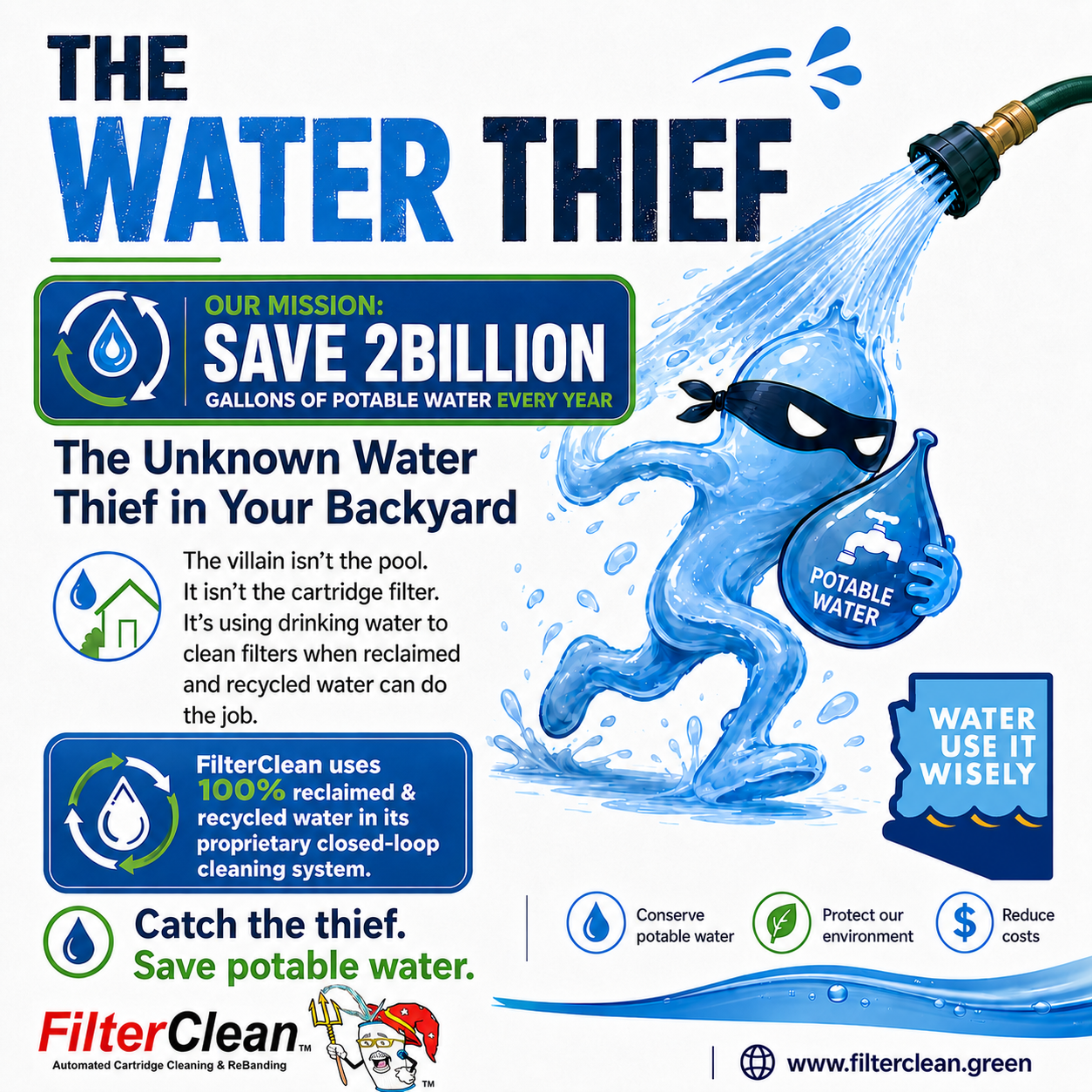
It isn’t necessarily a leaking faucet. It isn’t a broken irrigation line. And it isn’t the swimming pool itself.
It may be the way your pool filter is being cleaned.
Every time a cartridge filter is cleaned with a garden hose, treated potable water is used for a job that does not require drinking-quality water. Most homeowners probably never think twice about it because this is simply how pool filters have traditionally been cleaned.
That makes it a perfect water thief: quiet, routine, and unnoticed.
The Stakes Just Got Higher
That overlooked water use takes on greater significance as the federal government develops new Colorado River operating rules after 2026.
On July 31, 2026, the Bureau of Reclamation released its Final Environmental Impact Statement for post-2026 operations of Lake Powell and Lake Mead. The Final EIS is a major step in the process, but it is not yet the final Record of Decision. Reclamation has said a final operating decision is expected before the 2027 water year begins on October 1, 2026.
For Arizona, the larger message is difficult to miss: protecting our water future will require conservation at every level. Major agreements among states, Tribal Nations, agriculture, cities, businesses, and the federal government will matter enormously. But so will something much smaller—the gallons we choose not to waste.
And that brings us back to the unknown water thief in the backyard.
Not All Pool Filters Work the Same Way
Swimming pools commonly use three broad types of filtration: sand, diatomaceous earth (DE), and cartridge filters. Each has different operating and maintenance requirements.
Sand and DE systems typically rely on backwashing as part of routine maintenance, which discharges pool water, which then is replenished with potable water. Cartridge filters do not require routine backwashing, which is one reason they have become an increasingly attractive option for water-conscious pool design.
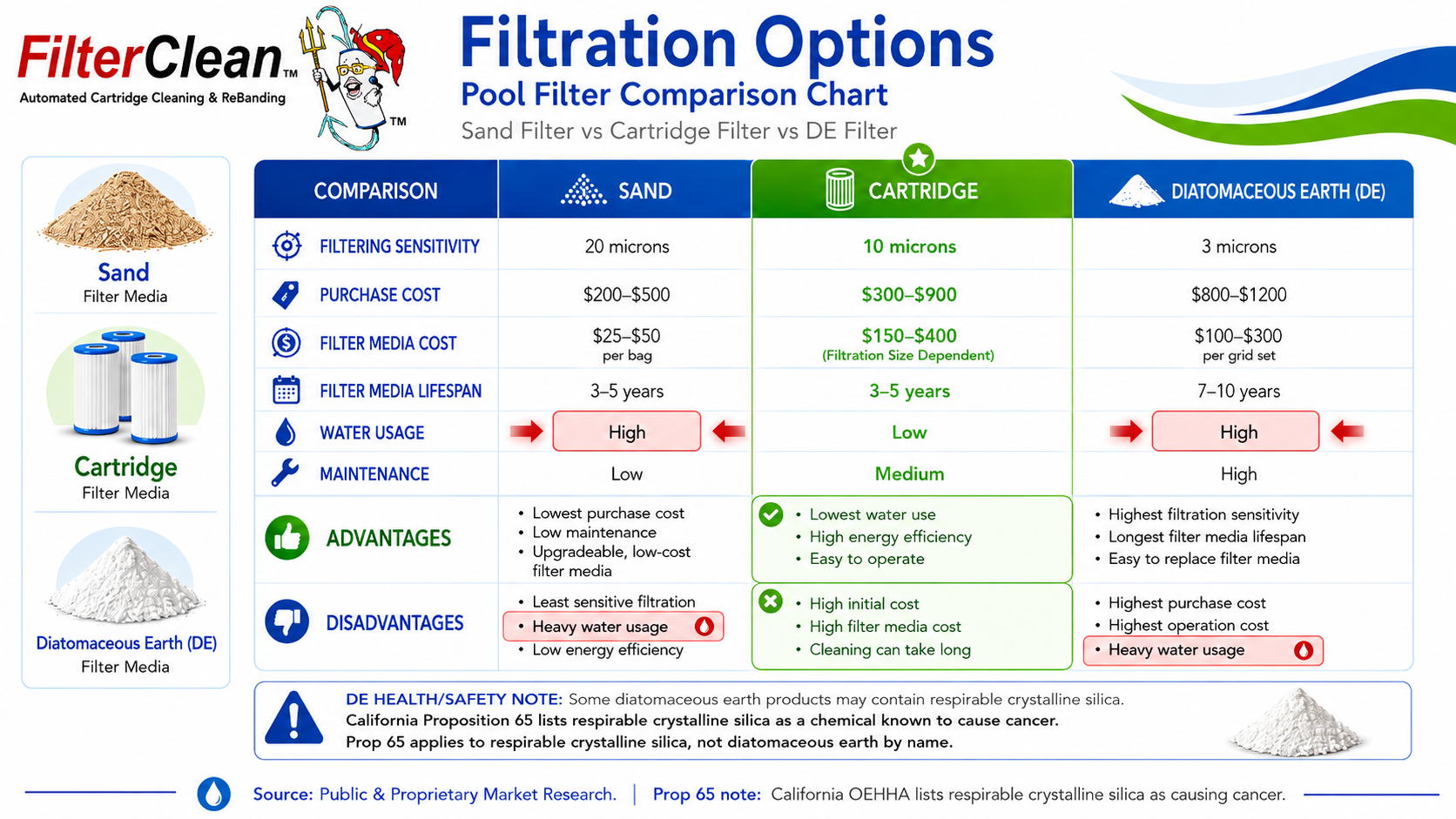
But cartridge filters have their own hidden water challenge: how they are cleaned.
The cartridge filter is not the villain. The problem is using potable water when a reclaimed-water alternative is available.
The thief is not the pool. It’s not the cartridge filter. It’s using drinking water when we don’t have to.
Catching the Water Thief
The problem is not that cartridge filters need cleaning. They absolutely do. A cartridge filter continuously captures dust, pollen, oils, minerals, sunscreen, and other debris as pool water moves through the filtration system. Eventually, the filter must be cleaned so water can continue flowing properly.
The real question is simple: why use potable water to do it?
FilterClean developed a proprietary closed-loop cleaning system that uses 100% reclaimed and recycled water. No fresh potable water is used to clean the cartridge filters. Instead, the cleaning water is captured, recirculated, and reused within the system.
The filter still gets professionally cleaned. But the Water Thief no longer gets access to Arizona’s drinking water.
But the Water Thief Isn’t Working Alone
Looking more closely at filter maintenance revealed something else: the Water Thief has accomplices.
They operate differently, but all of them quietly consume resources Arizona can afford to conserve.
 Accomplice #1: The Landfill
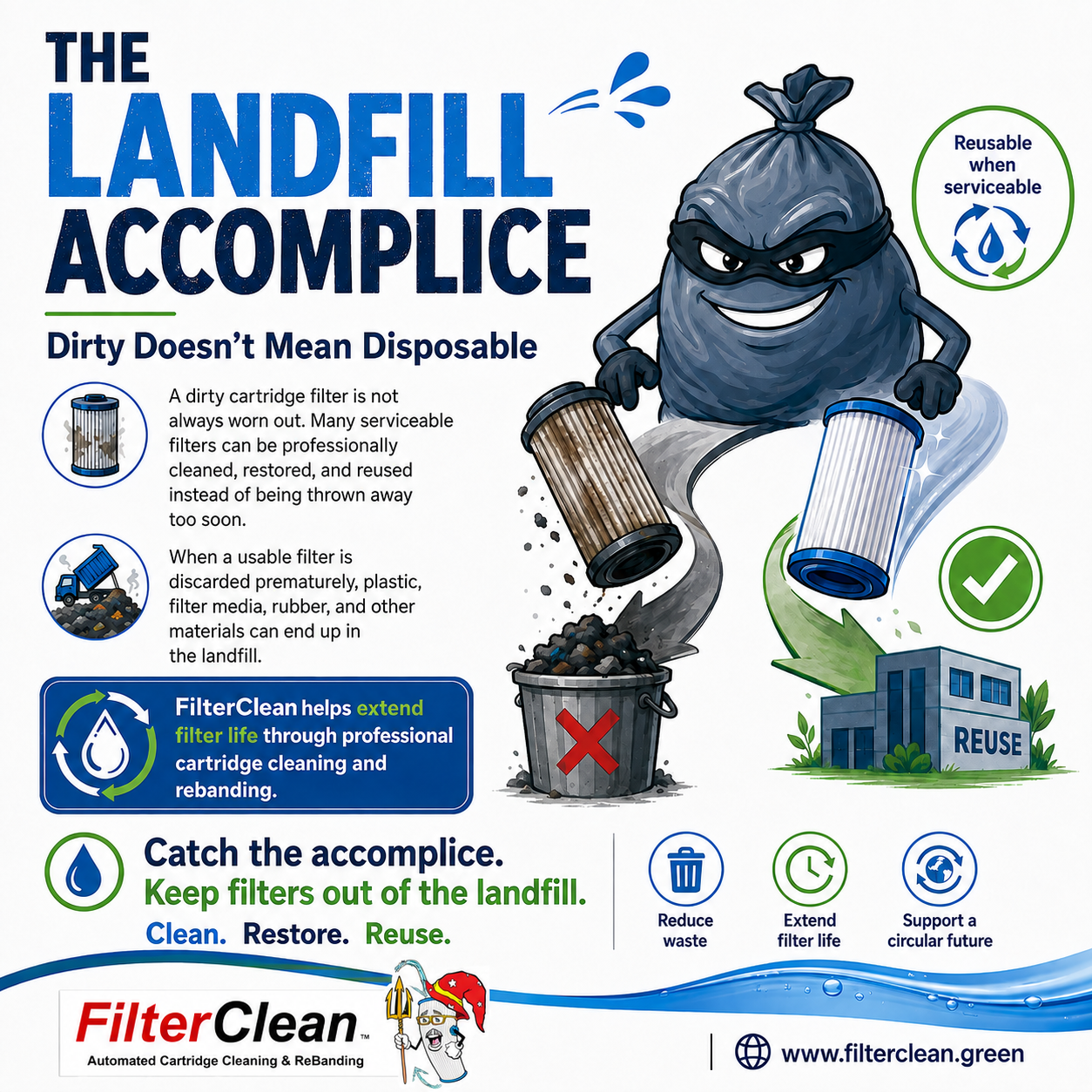
A cartridge filter that looks dirty does not necessarily need to be thrown away.
Pool cartridges contain plastic, synthetic filter media, rubber, adhesives, and other materials that are difficult to recycle. When a serviceable filter is discarded prematurely, those materials—and the resources used to manufacture and transport them—can end up in a landfill.
Professional cleaning can extend the useful life of a serviceable cartridge and delay unnecessary replacement. So while the Water Thief steals potable water, his first accomplice quietly steals useful life from products that may still have years of service remaining.
The answer is simple: clean it, restore it, reuse it.
Of course, filters eventually reach the end of their useful lives. Damaged filters, deteriorated media, or filters that can no longer perform properly should be replaced. But dirty and worn out are not the same thing.
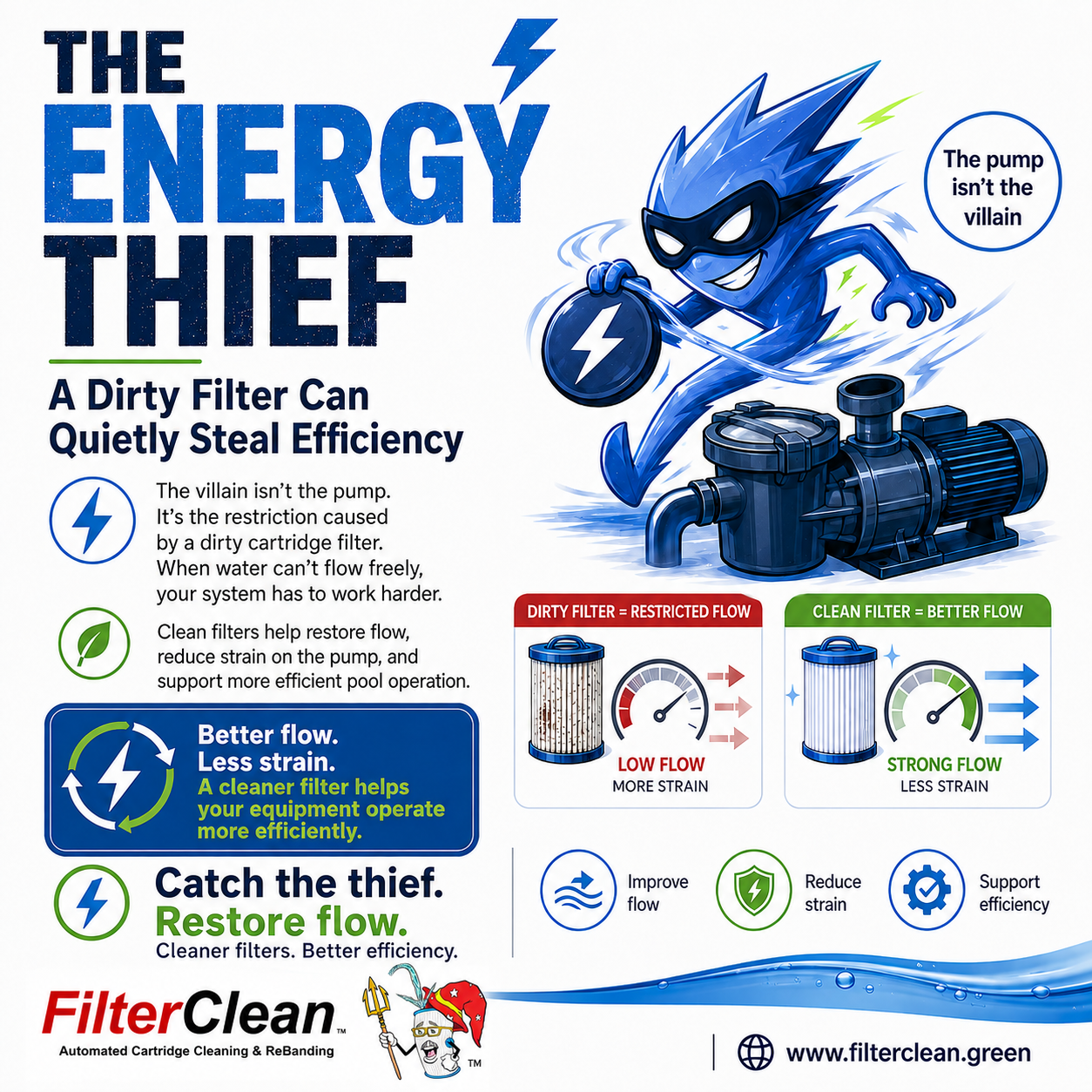
Accomplice #2: The Energy Thief
There is another accomplice hiding in the equipment area.
A dirty cartridge creates resistance to water flow. As debris accumulates, it becomes harder for water to move through the filter. Maintaining properly cleaned filters helps restore flow and allows the pool’s circulation system to operate closer to the way it was designed.
The exact energy savings will vary from pool to pool depending on the pump, plumbing, operating schedule, and condition of the filtration system. But the principle is straightforward: when water can move more easily, the system does not have to fight unnecessary resistance.
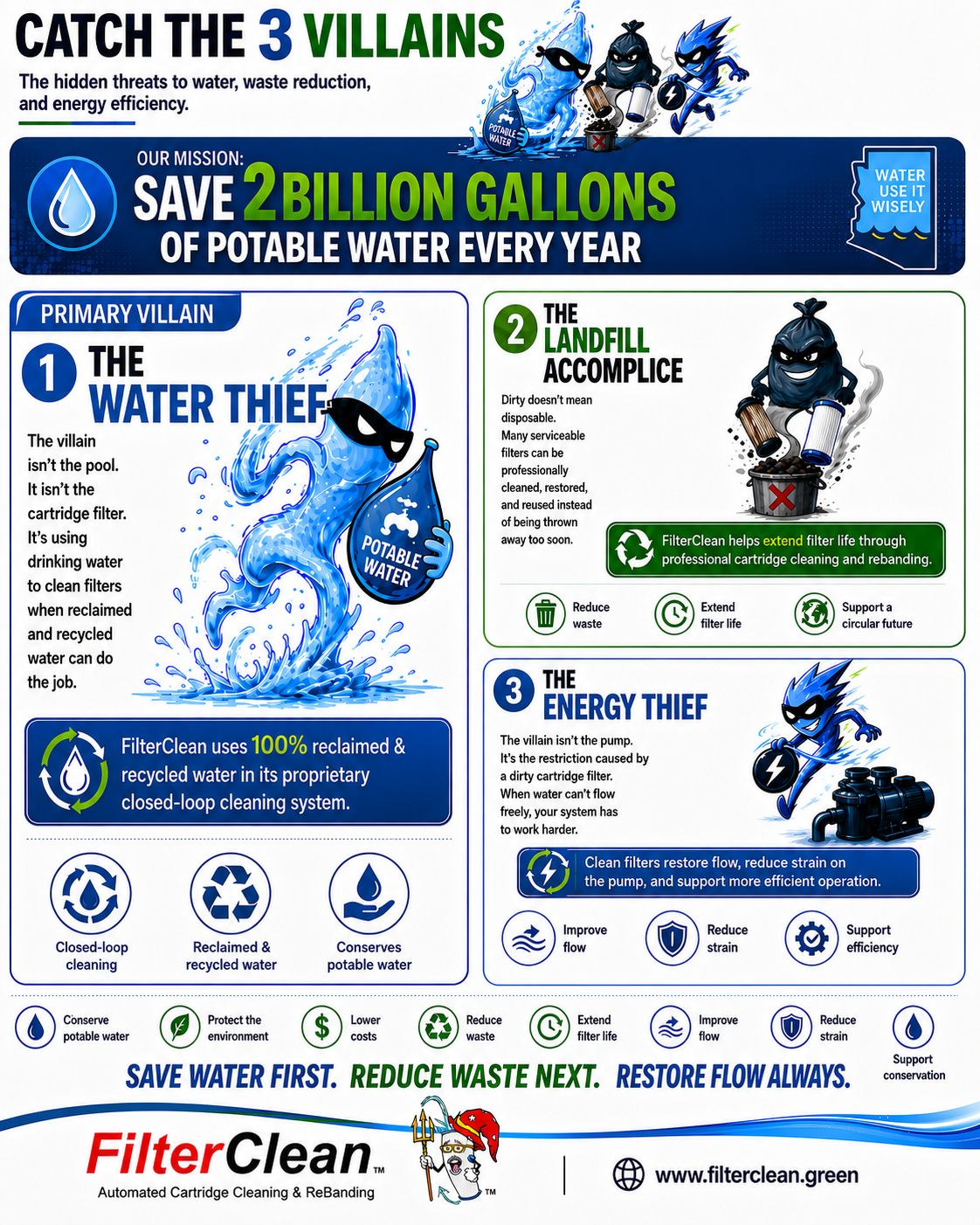
So now our backyard mystery has three characters: the Water Thief wastes potable water, the Landfill Accomplice wastes useful materials, and the Energy Thief wastes efficiency.
One Solution. Three Conservation Benefits.
This is where the story comes full circle.
FilterClean’s closed-loop process was created to address the Water Thief—to eliminate potable water from the cartridge-filter cleaning process by using 100% reclaimed and recycled water.
But cleaning and reusing a serviceable cartridge instead of prematurely discarding it can also reduce landfill waste. And returning a dirty filter to proper operating condition can support better flow and more efficient pool operation.
– – – – – – – – – –
The Water Thief Is Small. The Opportunity Isn’t.
One cartridge filter may seem insignificant compared with the enormous challenges facing the Colorado River. And one homeowner changing how a filter is cleaned will not solve Arizona’s water challenge.
But that is not how conservation works.
Arizona has hundreds of thousands of swimming pools. When homeowners, pool professionals, commercial properties, and municipalities change one routine practice, individual decisions can add up to meaningful conservation.
FilterClean’s mission is to help Arizona save 2Billion gallons of potable water annually by changing the way cartridge filters are cleaned. The technology already exists. The water can already be reclaimed and recycled. The filters can already be professionally cleaned and reused.
What we need now is awareness, partnership, and adoption.
Catch the Thief in Your Own Backyard
Federal policy will determine how Colorado River shortages are ultimately managed. Cities will continue investing in infrastructure. Agriculture will continue improving water efficiency. Businesses will keep looking for new conservation technologies. And homeowners will continue making decisions about how they use water every day.
All of those actions matter.
But sometimes conservation begins with a surprisingly simple question: Are we using drinking water to do a job that reclaimed and recycled water could do instead?
The next time your cartridge filter needs cleaning, take a closer look.
Because the Unknown Water Thief may be closer than you think.
He may be hiding right in your backyard.
– – – – – – – – – –
U.S. Bureau of Reclamation, Colorado River Post-2026 Operations, Final Environmental Impact Statement, July 31, 2026.
U.S. Bureau of Reclamation, Post-2026 Operational Guidelines and Strategies for Lake Powell and Lake Mead.
Arizona Department of Water Resources, Arizona response to the July 31, 2026 federal Colorado River action.
Page Gray is the Owner of FilterClean LLC, an Arizona company that uses a proprietary closed-loop system to clean cartridge filters with 100% reclaimed and recycled water. Since acquiring FilterClean in 2022, Page has expanded the company’s mission across residential, commercial, industrial, and heavy-duty filtration, with a focus on potable-water conservation, landfill-waste reduction, and energy-conscious maintenance. Learn more at www.filterclean.green.
Editor’s Note: As part of an ongoing series, Water – Use It Wisely is highlighting water-saving products, technologies, and innovative approaches that can help improve water-use efficiency. Featured articles are intended for educational purposes only and do not constitute an endorsement of any specific company, product, or service.